


National Skills Qualification Framework
Ministry of Education
A National Skill Training Provider Considering from Govt. of India New Delhi
In pursuance of National Policy on Education 2020 by Ministry of Education
This is a title
SKILL BASED EDUCATION
National Skills Qualifications Framework
Government of India, taking note of the requirement for skill development among students, launched National Vocational Education Qualification Framework (NVEQF) which was later on assimilated into National Skills Qualifications Framework (NSQF). The CHRED Skills Universe Various Sector Skill Councils are developing Qualification Packs (QPs), National Occupational Standards (NOSs) and assessment mechanisms in their respective domains, in alignment with the needs of the industry. In view of this, the AICTE implemented the scheme of Community Colleges from 2013- 14 in pilot mode on the initiative of the MHRD.
Ministry of Education
CHRED Skills Universe
Guidelines for providing Skill Based Education
under National Skills Qualifications Framework
National Skills Qualifications Framework
Work Integrated On The Job Practical Training Programme
The National Skills Qualifications Framework (NSQF) is a competency-based framework that organizes qualifications according to a series of knowledge, skills and aptitude. The NSQF levels, graded from one to ten, are defined in terms of learning outcomes which the learner must possess regardless of whether they are obtained through formal, non-formal or informal learning. National Occupational Standards (NOS) are statements of the skills, knowledge and understanding needed for effective performance in a job role and are expressed as outcomes of competent performance. They list down what an individual performing that task should know and also are able to do. These standards can form the benchmarks for various education and training programs to match with the job requirements. Just as each job role may require the performance of a number of tasks, the combination of NOSs corresponding to these tasks form the Qualification Pack (QP) for that job role. The NOSs and QPs for each job role corresponding to each level of the NSQF are being formulated by the Council of Human Resource Education Development set up by MSME National Employability Enhancement (MoU) with industry leadership. The curriculum which is based on NOSs and QPs would thus automatically comply with NSQF
TRADE SECTOR
Why Need Career
Development
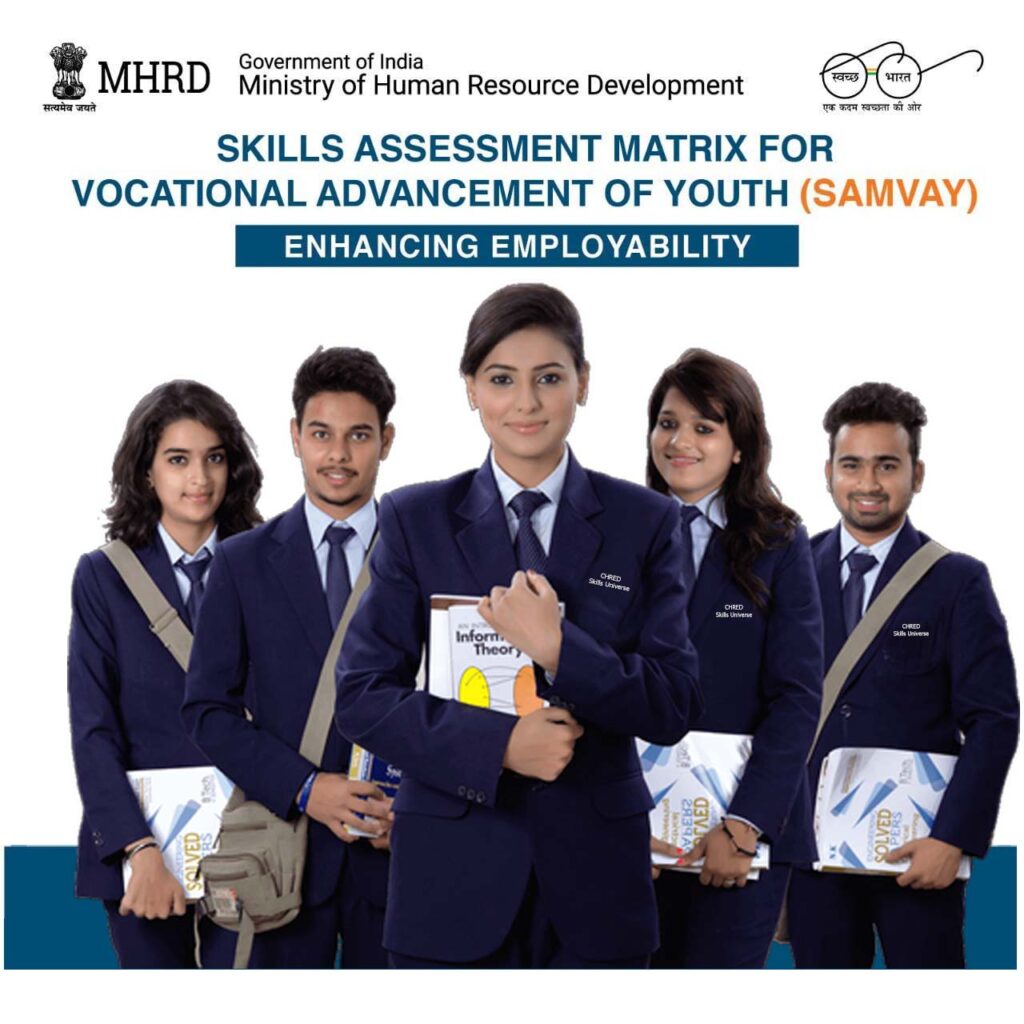
For Vocational Advancement of Youth
Every country develops its own system of education to express and promote its unique socio-cultural-economic identity besides meeting the challenges of time to leverage the existing potential opportunities. India, at present, is recognized as one of the youngest nations in the world with over 50% of the population under the age of 30 years. It is estimated that, India will have 200/o of the world's total workforce. In order to harness the full demographic dividend, India needs an educational system which is of high quality, affordable, flexible and relevant to the Industry, economy and to the society as a whole. The necessity, therefore, is to empower and enable India's young pcpulation to sustain a livelihood throughout their lives requires that educational institutes and government look beyond traditional pathways of education, employability and employment. Harnessing the demographic dividend through appropriate skill development efforts would provide an opportunity to achieve inclusion and productivity within the country and also a reduction in the global skill shortages. The 'vocational Education' had been in vogue, but it did not get the level of acceptance by the society in comparison with academic programs. Efforts are being made to introduce compulsory and optional vocational subjects at school level. But their acceptance for mobility into higher education is a major challenge.
Designated Trades and Sectors
Health Care Sector
Explore list of handyman services services electrical help.

Fire & Safety Sector
Explore list of handyman services services electrical help.

Pharmaceutical Sector
Explore list of handyman services services electrical help.

Healthcare Services
Explore list of handyman services services electrical help.
OBJECTIVE
Type of Courses and Awards
Skill-based programmes can be offered at the level of certificate, diploma, advanced• diploma, B.Voc, P.G. diploma, M.Voc and research as per details given below
These will be full-time credit-based modular programmes, wherein banking of credits for skill and general education components shall be permitted so as to enable multiple exit and entry. These should not be conducted as add on programmes. The multiple entry and exit enables the learner to seek employment after· any level of award and join back as and when feasible to upgrade qualifications / skill competencies either to move higher in the job profile or in the higher educational system. This will also provide the learner an opportunity for vertical mobility to second year of B.Voc degree programme after one year diploma and to third year of B.Voc degree programme after a two year advanced diploma. The students may further move to Masters and Research degree programmes mapped at NSQF Level 8 –10 In order to make education more relevant and to create ‘industry fit’ skilled workforce, the institutions offering skill based courses will have to be in constant dialogue with the industry and respective Sector Skill Council(s) so that they remain updated on the requirements of the workforce for the local economy. These institutions should also preserve and promote the cultural heritage of the region, be it art, craft, handicraft, music, architecture or any such thing, through appropriately designed curriculum leading to gainful employment including self-employment and entrepreneurship development
OUTCOMES
The specific outcomes expected from implementation of NSQF are as follows
Mobility
Mobility between vocational and general education by alignment of degrees with NSQF.
RPL
Recognition of Prior Learning (RPL), allowing transition from non-formal to organized job market
Standardization
Standardized, consistent, nationally acceptable outcomes of training across the country through a national quality assurance framework.
Global mobility
Global mobility of skilled workforce from India, through international equivalence of NSQF.
progression pathways
Mapping of progression pathways within sectors and cross-sectorally.
National Standards
Approval of NOS/QPs as national standards for skill training.
DOWNLOADS
Download Relevant Documents
NSQF Guideline (PDF)
How to Register
Industry Partnership Brochure (PDF)
Sample MoU (World Document)
NSQF Notification (pdf)
Common Norms (pdf)